‘Black People Are Not Apes’ Is Not A Political Strategy
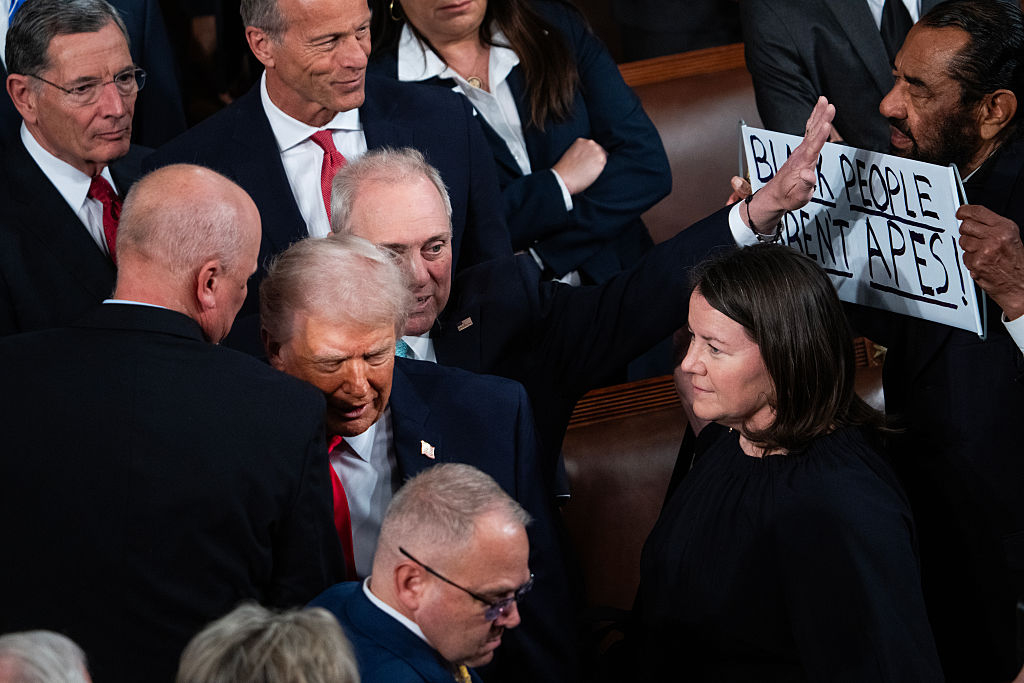
Source: Tom Williams / Getty “Black People Are Not Apes.” That sentence should not be necessary in 2026. During Black History Month. It should not need to be printed, displayed, or defended inside the United States Capitol. And yet, there it was, elevated as a form of protest during last night’s State of the Union. [...]


“Black People Are Not Apes.”
That sentence should not be necessary in 2026. During Black History Month. It should not need to be printed, displayed, or defended inside the United States Capitol. And yet, there it was, elevated as a form of protest during last night’s State of the Union.
But the harder truth is that the real humiliation wasn’t the existence of the sign. It was that this is what the Democratic Party’s opposition looks like right now.
A sign.
A sentence.
A placard held at chest level while power walks past it unmoved.
That is not resistance.
While executive authority expands, federal agencies are reshaped, immigration enforcement hardens, people die in ICE custody, civil rights protections are dismantled, and courts are stocked for decades, the Democratic Party lifts a slogan into the air and calls it confrontation. While Trump continues deploying language that dehumanizes entire communities, the Democratic Party keeps responding with symbolism.
The Party’s response keeps shrinking into gestures, carefully timed dissent, contained outrage, and social media and television-ready disruption that dissolves the moment the cameras cut away. And the balance of power remains exactly where it was. The Party seems trapped in a cycle of expressive resistance that’s high on moral clarity and low on structural consequence.
Rep. Al Green’s sign says “Black People Are Not Apes!”
Fine.
But where is the legislation that blocks the policy architecture behind the rhetoric?
Where is the procedural warfare? Where is the coordinated, relentless obstruction that makes authoritarian overreach and structural racism unsustainable?
Trump does not operate within a shame-based political framework. He does not adjust his behavior in response to public rebuke. His brand is defiance. His appeal is confrontation. His power base rewards escalation, not introspection.
So what exactly is a sign about zoology supposed to accomplish?
It does not slow executive orders. It does not redirect federal agencies. It does not constrain enforcement mechanisms. It does not build legislative coalitions. It registers moral objection, and then power continues moving.
For years now, Democratic leadership has treated spectacle as strategy. The assumption appears to be that exposure alone weakens authoritarian and racist behavior. That if voters just see enough cruelty, enough extremism, enough provocation, they will recoil. But spectacle is Trump’s native language. He thrives inside it. Meeting spectacle with spectacle is not counter-programming. It’s amplification.
Meanwhile, communities on the ground are dealing with material consequences: deportations, regulatory rollbacks, massive job losses, hunger and sickness, attacks on public education, erosion of voting protections, and judicial appointments that will shape law for decades. None of that shifts because a congressman held up a sign.
If Democrats want to be taken seriously as a counterweight, they must demonstrate something more than moral differentiation. They must demonstrate strategic discipline.
And what would that look like?
That would mean procedural obstruction where possible. Coordinated state-level resistance. Forcing votes that create political cost. Sustained investigations tied to messaging. Using committee assignments as leverage points instead of press platforms. Understanding that authoritarian drift is institutional and not theatrical.
Black voters, in particular, are not confused about what’s at stake. We understand dehumanization. We recognize coded rhetoric. We know how language becomes policy. What is harder to accept is watching the Party that relies most heavily on our turnout respond to those stakes with gestures that feel emotionally satisfying but politically weightless.
There is a widening gap between the scale of the threat and the scale of the response. And that gap erodes confidence. If a president is consolidating power, the opposition must respond with coordinated structural countermeasures, not symbolic disruptions designed for camera cycles.
A sign can capture attention. It cannot shift authority. A slogan can trend. It cannot dismantle policy. The Democratic Party’s challenge right now is credibility. Not rhetorical credibility but strategic credibility. Voters need to see evidence that leadership understands power as something to be exercised, not merely critiqued.
Because the uncomfortable reality is that authoritarian movements and white supremacist campaigns do not collapse under moral pressure. They are resisted through organized, sustained institutional force. That requires risk and escalation. It requires moving beyond decorum when decorum is being weaponized.
“Black People Are Not Apes” should never have to be declared inside Congress. But the deeper indictment is that if this declaration is the most visible form of resistance we can muster in this political moment, then the problem is bigger than rhetoric.
If a sentence on a sign is the sharpest tool Democrats are willing to use, then the problem is not Trump.
It’s muscle.
Dr. Stacey Patton is an award-winning journalist and author of “Spare The Kids: Why Whupping Children Won’t Save Black America” and the forthcoming “Strung Up: The Lynching of Black Children In Jim Crow America.” Read her Substack here.
SEE ALSO:
State Of The Union 2026: This Man Be Lying Edition
President Trump Sang The Same Old Song During State Of The Union Address
Share
What's Your Reaction?
 Like
0
Like
0
 Dislike
0
Dislike
0
 Love
0
Love
0
 Funny
0
Funny
0
 Angry
0
Angry
0
 Sad
0
Sad
0
 Wow
0
Wow
0